
Before You Decide What to Say, Find Your North Star
Why every effective professional conversation starts with a clear objective
PROFESSIONAL COMMUNICATION
7/13/2026


One of the biggest lessons I learned during my 20 years working in marketing strategy is this:
Everything starts with a clear objective.
Before you think about the wording, the design, the campaign or even the product itself, you first ask:
“What am I trying to achieve?”
That objective becomes your North Star and guides every decision that follows:
“Who is this product for?”
“What problem am I solving?”
“Which features matter most?”
“What benefits should I emphasise?”
“How should I position and communicate it?”
Without a clear objective, even excellent marketing can miss the mark.
Over the years, I’ve realised that the same principle applies to professional communication. The objective changes, but the thinking doesn’t.
You can explain yourself perfectly, present compelling arguments and answer every question, yet still leave the conversation without achieving what you actually wanted.
Why? Because communication, just like marketing, isn’t an end in itself. It’s a means of achieving an outcome. And that outcome should be clear before you decide what to say.
We’ve been asking the wrong question
I recently posted a note on Substack where I wrote:
“Don’t decide what to say first. Decide what needs to happen next. The message follows.”
Yet a lot of people instinctively begin by asking: “What should I say?”
However, a better starting point may be: “Why am I saying it?”
“Why this conversation?” “Why now?” “Why do I feel the need to say anything at all?”
Keep asking why, and eventually you’ll stop thinking about the conversation and start thinking about the outcome.
That’s your objective; your North Star.
The conversation isn’t the objective
I've noticed that when clients describe workplace conversations that didn't go as expected, they usually tell me what they said, rather than what they were trying to achieve.
They’ll say things like:
“I explained the situation to my manager.”
“I told my client what had happened.”
“I spoke to my colleague about the issue.”
But when we unpack the conversation together, it often becomes clear they never defined what they wanted the other person to understand, decide or do next.
Instead, they assumed that simply having the conversation would naturally lead to the outcome they wanted. It rarely works that way.
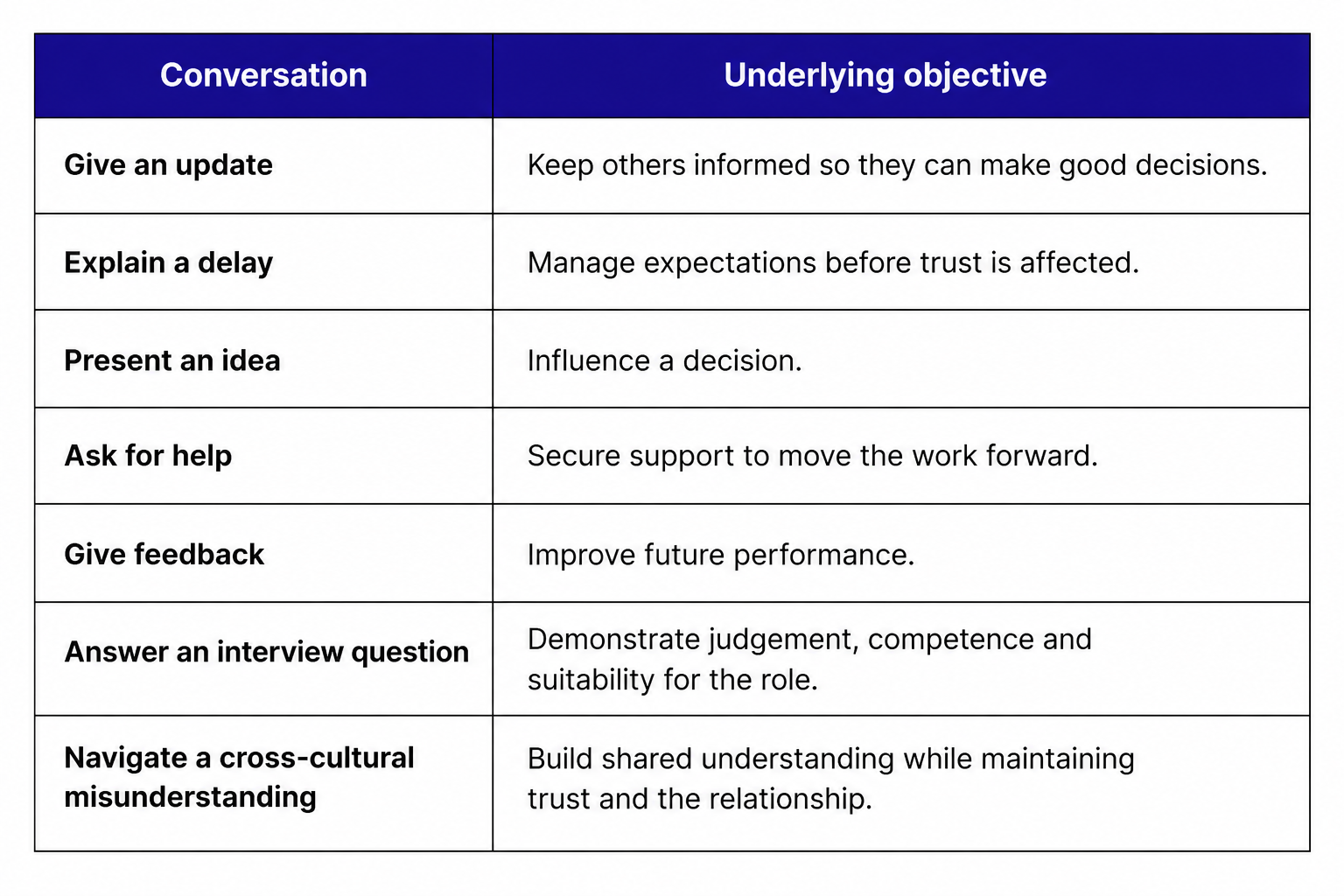
The difference becomes much clearer when you separate the conversation from the objective behind it.
Notice that the conversation is simply the vehicle. The objective is the destination.
What marketing taught me about communication
One of the quickest ways to weaken a marketing message is to lose sight of its primary objective.
Should the customer buy a product? Download a guide? Subscribe to the newsletter? Book a consultation? Browse a collection?
The more equally important actions you ask someone to take, the less clear your primary ask becomes.
Exactly the same thing happens in communication. We often try to explain what happened, justify our recommendation, defend ourselves, reassure the other person, ask for support, provide extra context and anticipate objections… all before we’ve even decided what the conversation is actually supposed to achieve.
It’s a bit like having so many priorities that you end up needing a list of priorities for your priorities. When everything is important, nothing is.
How to define your communication objective
If you’re not sure what your objective is, I’ve found these three questions to be a useful place to start.
1. Why am I having this conversation?
Keep asking why until you stop describing what you’re doing and start describing what you’re trying to achieve.
2. What needs to be different when this conversation ends?
Think in terms of before and after.
Before: The deadline is fixed.
After: We’ve agreed to extend it by two days.
Before: My manager doesn’t know I need additional support.
After: They’ve approved additional resources.
Before: The client is uncertain.
After: They understand what’s changed and what happens next.
That after is usually your objective.
3. If this conversation could achieve only one thing, what would it be?
Trying to achieve five objectives at once usually weakens all of them. Decide on your primary objective first. Everything else should support it.
Final thoughts
Communication isn’t just about choosing better words, phrases or scripts.
It’s about helping the right things happen. It’s the mechanism that helps us get there.
And every good communication decision starts with one question:
"What needs to happen when this conversation ends?"
Your objective is your North Star. Everything else follows.
Next in this series...
Having a clear objective is the first communication judgement.
The next challenge, and one of the biggest hurdles I see in coaching, is this:
"How do I know what’s important to the person I’m speaking with?"
We’ll explore why understanding your audience’s responsibilities, the decisions they’re trying to make, and the information they need can completely change the way you communicate.
_ _ _
I write about communication, judgement, and the decisions that shape how our messages are understood. If that's an area you're interested in exploring, feel free to subscribe to my newsletter on Substack (link below).
Connect
natascha@confidentverbalist.com
© 2026 Confident Verbalist, a brand owned by Human Defined LLC. All rights reserved.
Newsletter
Practical communication insights, frameworks, and real-world examples delivered directly to your inbox.