
Read the (intercultural) room: why silence doesn’t mean the same thing in every culture
How cultural context shapes the way people interpret silence, participation, disagreement, agreement, and professionalism at work.
PROFESSIONAL COMMUNICATIONINTERCULTURAL COMMUNICATION
5/18/2026


There’s a common assumption many professionals make in meetings:
If someone is silent or doesn’t immediately respond, people often assume one of several things:
they disagree
they aren’t interested
they’re uncertain
or they don’t have anything to contribute
But depending on the cultural or professional context, silence may equally signal agreement, reflection, attentiveness, respect for hierarchy, or simply a preference not to interrupt.
This is where communication can easily break down in international or multicultural environments. The same behaviour can carry very different meanings depending on workplace norms, hierarchy, communication culture, or the situation itself.
One of the biggest communication mistakes people make is treating behaviour as universal when it’s actually contextual.
Silence is one example of that.
The problem with interpreting behaviour too quickly
In some professional cultures, speaking quickly and contributing openly is seen as a sign of engagement, confidence, and initiative.
In others, speaking too quickly can be perceived very differently: impulsive, disruptive, overly certain, or even disrespectful toward hierarchy or group process.
This is where communication problems often begin. Not because someone communicated “badly,” but because the situation was interpreted through the wrong lens.
For example, in some cultures, people may wait to be invited into the discussion rather than volunteering opinions immediately. In others, people may avoid openly disagreeing in group settings to preserve harmony or avoid causing embarrassment.
That doesn’t mean they lack opinions, expertise, or engagement. It means the communication norms are different.
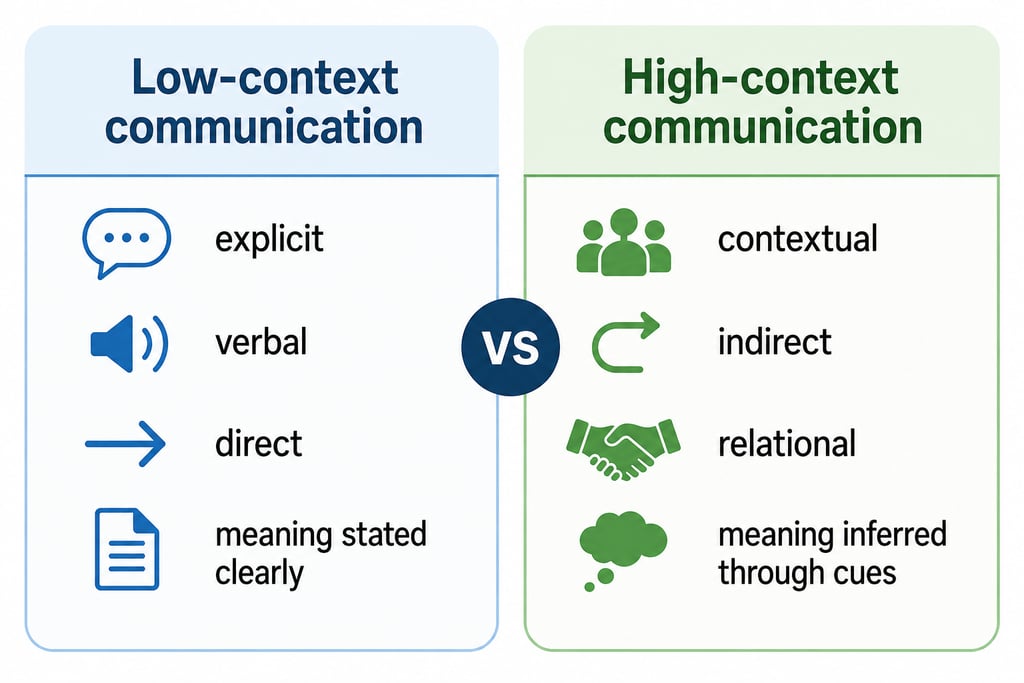
A quick example: high-context vs low-context communication
Anthropologist Edward T. Hall described cultures broadly as either high-context or low-context communication environments.
In lower-context cultures (for example, Germany, the Netherlands, or the United States), communication is often expected to be explicit and direct. Participation tends to be verbal and visible. Speaking up quickly is often interpreted positively: engaged, proactive, confident.
In higher-context cultures (for example, Japan, South Korea, or many Arab cultures), more meaning is carried through context, timing, hierarchy, tone, and non-verbal cues. People may contribute more selectively, avoid open disagreement, or wait to be invited into discussion.
The same silence that one person interprets as disengagement or disagreement may therefore be interpreted by someone else as agreement, professionalism, reflection, or respect.
Where this creates problems at work
This shows up regularly in international teams...
Someone interprets a quiet colleague as lacking confidence or not contributing enough.
A manager assumes agreement because nobody openly objected.
A direct communication style is perceived as efficient by one person and aggressive by another.
An indirect suggestion is interpreted as optional when it was actually intended seriously.
The issue is rarely language alone. It’s the interpretation sitting underneath the interaction.
Some of these differences also overlap with broader cultural dimensions identified by Geert Hofstede, particularly around hierarchy, group harmony, and uncertainty avoidance. In some environments, for example, speaking cautiously or waiting before contributing may reflect professionalism and careful judgement rather than hesitation.
Strong communicators read situations before reacting to them
One of the most important professional communication skills is learning to separate observation from interpretation.
Observation: “Nobody responded immediately.”
Interpretation: “They disagree.” “They’re disengaged.” “They didn’t understand.”
Those are not the same thing.
Strong communicators pause before assigning meaning too quickly. They look at the broader context:
What are the norms in this environment?
How is disagreement usually expressed here?
What role do hierarchy and seniority play?
Are people expected to volunteer opinions, or invited into discussion?
Is directness valued here, or softened?
That situational awareness changes how you respond.
This is why communication is really about judgement
People often approach communication as a speaking problem: “How do I say this better?”
But communication is usually a matter of judgement first: before we speak there is an internal selection process — often automatic — where we filter, prioritise, and frame information based on context and learned patterns.
You’re constantly making decisions about:
what matters
how direct to be
how strongly to position something
how much context is needed
and how the other person is likely to interpret what you say
The same message can succeed or fail depending on whether those decisions fit the situation.
Final thought
Not every silence means disagreement. Not every direct communicator is rude. Not every indirect communicator is uncertain.
A large part of professional communication is learning to read situations more accurately before reacting to them.
Because once you stop assuming that everyone communicates the same way you do, conversations become much easier to navigate.
----
If this reflects situations you’ve experienced in international or multicultural environments, follow along for more practical insights on communication, judgement, and navigating workplace interactions with greater clarity and intent.
Connect
natascha@confidentverbalist.com
© 2026 Confident Verbalist, a brand owned by Human Defined LLC. All rights reserved.
Newsletter
Practical communication insights, frameworks, and real-world examples delivered directly to your inbox.